Clean water is a daily need, but the way water is treated inside a home can affect taste, odor, flow and the suitability of water for drinking and cooking. For Bowral households, water filtration installation can provide a practical way to add targeted treatment where it is appropriate.
Choosing water filtration installation is not simply about buying a filter and connecting it to a pipe. The system needs to suit the water source, household demand, available pressure and contaminants that need to be reduced. Correct sizing and installation can also make ongoing maintenance easier.
Why Is Water Filtration Installation Important for Bowral Homes?
A water filtration installation works by passing water through one or more treatment stages designed for particular impurities. Depending on the technology, a system may reduce sediment, chlorine-related taste and odour, some dissolved substances or selected microorganisms. No single filter removes everything, so the treatment objective matters.
NSW Health notes that treated public drinking water is generally safe to drink and that there is not always a need to filter it. Filtration may nevertheless be used to improve taste or address specific water-quality concerns. Filters also need regular replacement and maintenance because an exhausted filter may become ineffective.
This makes water filtration installation a matter of matching equipment to a household requirement rather than choosing a system based only on marketing claims. For properties using rainwater, groundwater or another private source, testing and appropriate treatment become even more important.
What Does Water Filtration Installation Involve?
A properly planned water filtration installation usually begins with understanding where the water comes from and how the property uses it. A kitchen drinking-water filter has different requirements from a whole-house system supplying showers, laundry and multiple bathrooms.
An installer may consider water source, household demand, pressure, filter capacity, servicing access and whether additional treatment is required.
This helps avoid a filter that works but is poorly matched to the property. NSW Health also highlights capacity, filter type, pre-filtration and suitable certification when selecting filtration equipment.
Choosing the Right Water Filtration System
A useful approach to water filtration installation is to start with the problem you are trying to solve. Different water filtration systems are designed for different purposes. Activated carbon, ceramic, sediment, ion exchange and reverse osmosis technologies do not perform the same job.
Activated carbon is commonly used for taste and odor improvement, while sediment filters can capture particles such as dirt and rust. Reverse osmosis can remove a broad range of dissolved contaminants, but it has different flow, maintenance and wastewater considerations.
If the concern is mainly taste, a simple drinking-water filter may be sufficient. If the property has a private water supply, a broader treatment design may be needed.
| Filtration option | Common purpose | Key consideration | Typical application |
| Sediment filter | Reduces suspended particles | Can clog and restrict flow |
Pre-filtration or point-of-entry |
|
Activated carbon |
Helps improve taste and odor | Cartridge needs regular replacement | Drinking water or kitchen tap |
| Ceramic filter | Reduces selected particles and microorganisms | Does not remove every contaminant |
Point-of-use drinking water |
|
Ion exchange |
Reduces hardness or selected dissolved substances | Media needs replacement or regeneration | Specific water-quality issues |
| Reverse osmosis | Reduces many dissolved contaminants | Requires suitable pressure and maintenance |
Drinking-water treatment |
How Does Water Filtration Installation Support Drinking Water Quality?
Water filtration installation does not determine water quality by itself. The incoming water, plumbing, storage conditions, filter technology and maintenance all play a role.
For private water sources, testing can identify the treatment required. NSW Health advises testing and appropriate treatment, including disinfection, before such water is used for drinking, cooking or personal hygiene.
For authoritative guidance, homeowners can review the NSW Health information on private water supplies and treatment requirements. This is particularly useful when a property relies on a rainwater tank, bore, dam or other independent source.
Water filtration installation should therefore be considered as one part of a wider water-quality strategy. A filter may improve particular characteristics, but it should not be assumed to make an unsuitable supply safe unless the complete treatment process is appropriate.
When Should You Consider Water Filter Installation?
There are several reasons a homeowner may investigate water filtration installation. A noticeable change in taste or odour can prompt a closer look, while visible sediment or recurring filter problems may indicate that the existing setup needs attention.
Other situations include installing a new kitchen, replacing an old filtration unit, moving into a property with a private water source, or wanting treatment at selected taps rather than throughout the house.
It is also worth checking the manufacturer’s specifications before replacing a cartridge or upgrading equipment. A filter designed for one contaminant should not automatically be assumed to remove another. Certification and performance information can help homeowners compare systems more accurately.
Point-of-Use or Whole House Water Filtration?
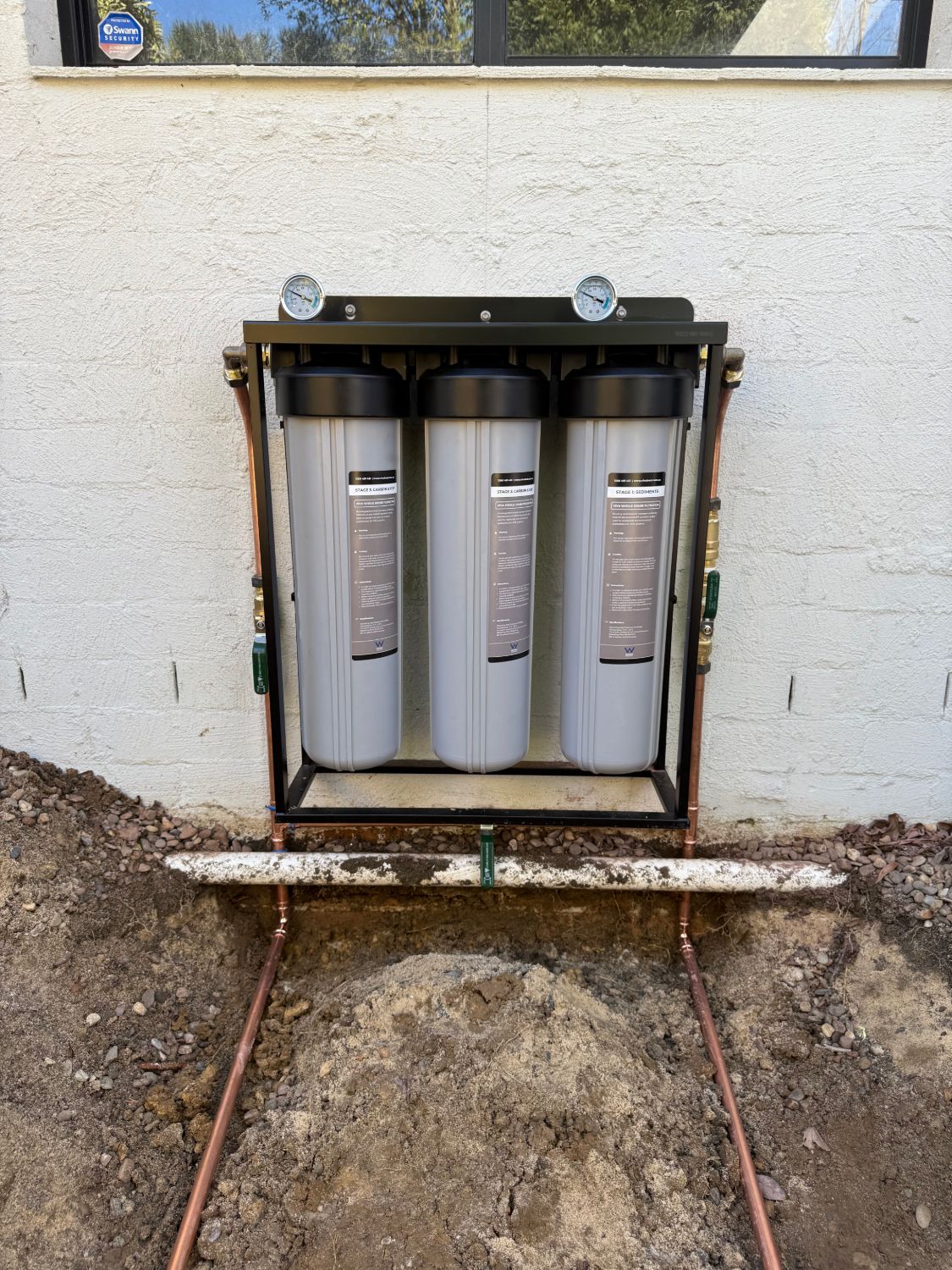
The right configuration for water filtration installation depends on how the household intends to use treated water. Point-of-use treatment focuses on a particular tap, commonly in the kitchen. Whole house water filtration can serve multiple outlets. Equipment must still be sized for household flow demand.
A point-of-use arrangement may suit drinking and cooking, while whole house water filtration can provide treated water at multiple outlets. Larger systems may require additional space, accessible service points and suitable plumbing connections.
The choice also affects installation complexity, space, service access and plumbing connections.
Why Professional Water Filtration Installation Matters
Although a cartridge looks simple, the surrounding plumbing still needs correct connections, flow direction and support. Poor connections or unsuitable pipework can create leaks and reduce system performance.
Professional water filtration installation can also help ensure that isolation valves, pressure requirements, drainage arrangements and service access are considered.
JRA Plumbing Services lists customised water filtration solutions along with installation and maintenance as part of its plumbing services for Bowral and the surrounding Southern Highlands. Its services page specifically describes water filtration system installation as a service designed around household water-treatment requirements.
How to Maintain a Water Filtration System
Maintenance is one of the most important parts of keeping a filtration system useful. Filter cartridges have a limited service life, and the replacement interval depends on the product, water quality and volume treated.
A simple maintenance routine should include checking the manufacturer’s instructions, replacing cartridges when required, looking for leaks and paying attention to changes in taste, odour or water flow.
NSW Health warns that filters should be maintained and replaced regularly because poorly maintained filters can become ineffective. In some circumstances, microorganisms may grow on filters and be released into the treated water.
Water filtration installation should therefore include a realistic plan for future servicing rather than treating installation as a once-only job.
Common Mistakes to Avoid
Homeowners sometimes focus on the filter itself and overlook the system around it. Buying the finest-micron cartridge available is not automatically the right solution because finer filtration can reduce flow and increase maintenance requirements.
Another mistake is assuming that every filtration product removes harmful microorganisms. NSW Health specifically notes that not all filters remove or inactivate them. Treatment needs to be selected according to the contaminant and intended use of the water.
It is also important not to ignore a boil-water notice simply because a property has a filter. During such an alert, filter suitability depends on the known contaminant and the certified performance of the equipment.
What Should You Ask Before Water Filtration Installation?
Before proceeding, homeowners can ask about the water source, suitable system type, required flow rate, certified contaminant reduction, cartridge replacement and ongoing servicing.
These questions help turn a general interest in filtration into a clear installation plan. They can also reveal whether testing is worthwhile before selecting equipment.
Conclusion
Clean water depends on more than the presence of a filter. The water source, treatment technology, plumbing arrangement, system capacity and maintenance schedule all influence how effectively a filtration setup performs.
For Bowral homeowners, water filtration installation can be a useful option when the system is selected for a defined purpose and installed to suit the property. It is especially important to distinguish between improving taste and odour and treating a supply that may present a genuine health risk.
If you are considering a new system, Get Professional Advice before choosing equipment so the proposed setup can be matched to your household’s water source and needs. JRA Plumbing Services provides water filtration system installation and related plumbing solutions across Bowral and the Southern Highlands.
FAQs
1. Is water filtration installation necessary for every Bowral home?
No. NSW Health states that treated public drinking water is generally safe to drink, so filtration is not automatically required. A filter may instead be chosen for taste, odour or a specific water-quality concern.
2. What type of filter is suitable for drinking water?
It depends on the contaminant and treatment objective. Activated carbon, ceramic and reverse osmosis systems have different capabilities, so the product should be selected using reliable performance information.
3. Is whole-house filtration better than a kitchen filter?
Neither option is universally suitable. A kitchen filter may meet drinking and cooking needs, while whole-house water filtration can treat water supplied to multiple outlets. Flow requirements and maintenance should be considered.
4. How often should water filters be replaced?
Replacement timing varies by product, water quality and usage. Follow the manufacturer’s instructions and replace cartridges when their rated capacity or service interval has been reached.
5. Can filtration make private water safe to drink?
Filtration alone may not be enough. Private water supplies can require testing, filtration and disinfection depending on the contaminants present. NSW Health recommends appropriate testing and treatment for private sources.